
RESOURCES / THE EVOLUTION BLOG
What Is Intent Intelligence? Understanding the Next Evolution of Fraud and AI Agent Security
Allie Yongue
Senior Marketing Manager

For years, digital fraud prevention and security have focused on answering one fundamental question: Who is interacting with my business?
Businesses have invested heavily in identity verification, device fingerprinting, authentication, bot detection, and transaction monitoring to establish whether a digital interaction can be trusted.
But knowing who someone is doesn't necessarily tell you what they're trying to do.
A legitimate customer can be manipulated into transferring money to a scammer. An authenticated account can be taken over. An authorized AI agent can begin a legitimate task and subsequently behave in ways that fall outside the customer's original intentions.
And an automated agent might complete a perfectly legitimate purchase without ever identifying itself as an agent.
These scenarios expose a fundamental limitation in traditional fraud and security approaches: Identity is only part of the equation. Understanding intent requires context.
This is where Intent Intelligence changes the conversation.
What Is Intent Intelligence?
Intent Intelligence is the continuous assessment of what a human, bot, or AI agent is trying to accomplish across a digital journey, using behavioral, device, identity, and journey-level signals to determine whether their actions are consistent with legitimate intent.
Rather than assessing risk at isolated checkpoints, Intent Intelligence evaluates how interactions unfold over time. It considers not just who is interacting with a business, but what they're doing, how they're doing it, and whether their actions make sense in the context of the entire journey.
For example, an individual logging into their bank account from a recognized device might initially appear trustworthy. But what happens if they suddenly start navigating unfamiliar areas of the application, demonstrate unusual behavioral patterns, add a new beneficiary, and initiate a large payment?
Each interaction might look legitimate in isolation. Together, they could indicate account compromise, social engineering, or coercion.
Intent Intelligence connects these signals to identify emerging risk before the transaction is completed.
The same principle applies to AI agents. An agent may have valid credentials and authorization to perform a task, but that doesn't automatically mean every subsequent action is appropriate.
Intent Intelligence moves fraud and security decisions beyond verifying identity toward continuously evaluating behavior and purpose.
Why Traditional Fraud Detection and Identity Verification Are No Longer Enough
Most digital security and fraud prevention solutions were built around specific events. A customer creates an account. A login is authenticated. A transaction is scored. A suspicious IP address is blocked.
These controls remain important, but they often operate independently, with limited understanding of the activity that occurred before or between them.
This creates three significant challenges.
- Legitimate identities can perform risky actions. Traditional authentication establishes that someone has successfully passed an identity or access check. It doesn't establish whether their subsequent actions are legitimate. Consider authorized push payment (APP) scams. A customer may authenticate successfully using their own device, complete multifactor authentication, and willingly authorize a payment. From an identity perspective, everything looks correct. Yet the customer may be acting under the influence of a fraudster. Detecting this requires understanding behavioral changes, unusual journey patterns, payment context, and other signals that may indicate coercion.
- Fraudsters exploit the gaps between checkpoints. Sophisticated fraud rarely happens at a single moment. An attacker might test credentials, access an account, change contact information, add a beneficiary, and initiate a payment. When security and fraud systems evaluate these events separately, they risk missing the relationship between them. An individual interaction may appear normal, while the sequence reveals a clear deviation from trusted behavior.
- AI agents are changing the nature of digital interactions. The growth of AI agents introduces an entirely new challenge. Historically, automated traffic was frequently treated as something to detect and block. But AI agents can now legitimately browse websites, compare products, manage accounts, and initiate transactions on behalf of consumers. This creates a difficult choice for businesses. Block automation too aggressively, and you risk rejecting legitimate customers and revenue opportunities. Allow automated traffic without understanding its purpose, and you potentially expose your business to fraud, abuse, and unauthorized actions. The question is no longer simply, “Is this a bot?” It's “Is this human or AI agent behaving in a way that is trusted, appropriate, and consistent with its intended purpose?”
How Does Intent Intelligence Work?
Intent Intelligence combines multiple dimensions of digital interaction data to build a continuously evolving understanding of trust and risk. Rather than relying on a single signal or static risk score, it evaluates how different signals relate to one another throughout a journey. Four signal families are particularly important.
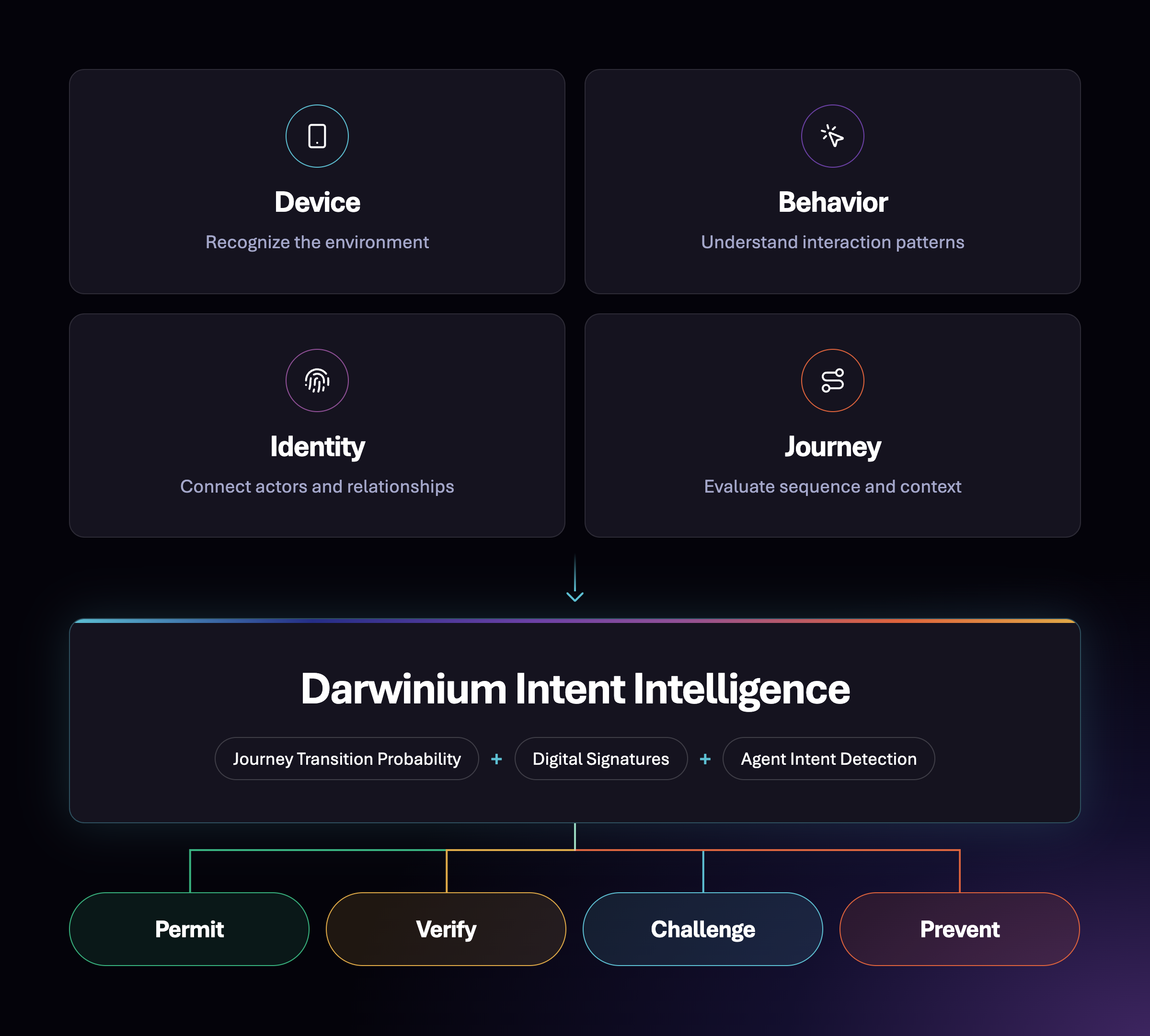
Device Intelligence: Is this a device we recognize?
Device intelligence examines characteristics of the technology being used to access a digital service. This can include device attributes, browser characteristics, network intelligence, TLS fingerprints, emulators, headless browsers, and attempts to disguise the environment; but recognizing a device is only the starting point.
A familiar device doesn't guarantee trustworthy activity, just as an unfamiliar device doesn't necessarily indicate fraud. Device intelligence becomes more valuable when combined with behavioral and journey context.
Behavioral Intelligence: Does the interaction look natural and familiar?
Behavioral intelligence examines how someone interacts with a digital environment. For human users, this might include typing cadence, mouse movements, touch interactions, navigation patterns, and time spent on different steps. These signals help establish whether current behavior is consistent with previous interactions or whether something has changed.
For example, an established customer might suddenly exhibit unfamiliar interaction patterns during a sensitive payment journey. That deviation could warrant additional scrutiny, particularly when combined with other risk indicators. For AI agents, the absence of human interaction signals can also provide useful context when assessing whether traffic is automated.
Identity Intelligence: Do the identifiers and relationships make sense?
Identity intelligence connects information such as accounts, devices, email addresses, phone numbers, networks, and locations. This helps establish relationships between interactions, recognize returning users, and identify suspicious connections.
For AI agents, identity intelligence can also incorporate emerging mechanisms for verifying agent identity and payment authorization. However, verifying that an agent is known or authorized doesn't necessarily establish that its behavior remains appropriate. That's where journey context becomes essential.
Journey Intelligence: Does the sequence of actions make sense?
Journey intelligence evaluates the path an individual or agent takes through a digital service. It examines which actions occur, the order in which they happen, the speed of transitions, and how those patterns compare with expected behavior. For example, two customers might complete exactly the same payment.
- One follows their familiar journey: login, account overview, payment selection, beneficiary confirmation, and payment.
- The other arrives through an unusual sequence, changes account details, adds a new beneficiary, and immediately initiates a large transfer. The payment itself may look similar.
The journey tells a very different story. By connecting device, behavior, identity, and journey intelligence, businesses can identify risk that traditional point-in-time controls may overlook.
The Difference Between Intent Intelligence and Traditional Fraud Detection
| Traditional fraud and security controls | Intent Intelligence |
| Evaluate individual transactions or checkpoints | Continuously evaluate the entire digital journey |
| Focus heavily on identity, devices, and isolated events | Combine identity with behavior, sequence, and context |
| Score individual requests or sessions | Evaluate how actions relate to the wider journey |
| Often treat humans, bots, and agents separately | Assess trust and risk across all digital actors |
| May identify fraud after a high-risk event | Can intervene before a risky action completes |
| Frequently rely on predefined integration points | Can apply intelligence and controls throughout a journey |
Importantly, Intent Intelligence doesn't replace identity verification, bot management, or transaction monitoring. It makes these capabilities more effective by connecting their signals to a broader understanding of user behavior and intent.
How Darwinium Delivers Intent Intelligence Differently
Understanding intent is one challenge. Being able to detect, evaluate, and act on that intelligence across every digital interaction is another. This is where Darwinium's approach is fundamentally different.
Darwinium brings together continuous journey intelligence, proprietary digital signatures, journey transition analysis, and real-time decisioning directly within the infrastructure businesses already use to deliver digital services.
1. Journey Transition Probability: Understanding the Meaning Behind the Sequence
One of Darwinium's key capabilities is Journey Transition Probability.
Traditional risk models often focus on the characteristics of an individual event.
Journey Transition Probability evaluates how expected or unexpected each step is within the context of the wider journey.
It considers the sequence and progression of interactions rather than treating every action as an isolated event.
This matters because fraud and abuse often involve actions that appear harmless individually but become suspicious when combined.
Imagine an AI shopping agent that begins by searching for products and comparing prices.
These are expected behaviors.
But what if the agent suddenly starts accessing unrelated account settings or attempting actions outside the expected purchasing flow?
Journey Transition Probability can identify unusual transitions and surface emerging risk as the journey unfolds.
The capability applies to humans, bots, and AI agents, helping businesses distinguish expected behavior from potentially malicious or unauthorized activity.
And because it can assess journey patterns from day one, businesses don't need to wait for an extensive history of individual customer interactions before beginning to identify unusual sequences.
2. Digital Signatures: Recognizing Trusted and Risky Behavior Over Time
Darwinium uses proprietary Digital Signatures to identify similarities across devices, behaviors, and other digital attributes.
Traditional identifiers, such as cookies or static device fingerprints, can become less reliable when users change devices, clear browser data, or deliberately mask their environments.
Darwinium's similarity-based approach provides a more flexible way to recognize returning interactions and detect related activity.
Rather than depending entirely on exact matches, Digital Signatures allow businesses to compare patterns and establish degrees of similarity.
For example, a customer might return with modified browser attributes but exhibit device and behavioral characteristics consistent with previous trusted activity.
Conversely, apparently unrelated accounts might exhibit highly similar behavioral signatures, suggesting coordinated abuse.
These capabilities support Intent Intelligence by connecting current actions with historical context, even when individual identifiers change.
3. One Journey Across Humans, Bots, and AI Agents
Fraud and security teams have traditionally relied on different technologies to address different threats.
Bot management handles automation. Identity solutions verify users. Fraud systems assess transactions. API security tools protect application interfaces.
But modern digital interactions increasingly cross these boundaries.
A legitimate customer might interact with a website directly, use a mobile application, and delegate a task to an AI agent.
Darwinium brings intelligence from web, mobile, API, and Model Context Protocol (MCP) interactions into a connected view of the journey.
This enables businesses to evaluate the actions of humans and agents within a consistent framework, rather than treating each interaction type as an entirely separate security problem.
The result is a more complete understanding of what is happening across the digital environment.
4. Agent Intent Detection and MCP Protection
AI agents introduce new security questions.
Is the agent genuinely acting on behalf of a customer? Has it been authorized to perform a particular action? Is its behavior consistent with that authorization?
Emerging standards such as Web Bot Auth, Visa Trusted Agent Protocol, Mastercard Agent Pay, and Google's Agent Payments Protocol (AP2) help establish important aspects of agent identity and authorization.
But identity and authorization alone don't answer whether an agent's behavior remains appropriate throughout its journey.
Darwinium adds a layer of continuous intent assessment.
Its Agent Intent Detection and MCP Protection capabilities are designed to help businesses evaluate agent activity, including interactions with MCP tools, against expected behavior and journey context.
For example, an AI agent might be authorized to research and purchase a product within specific parameters.
Intent Intelligence helps determine whether its subsequent actions remain consistent with that legitimate task or whether the journey has taken an unexpected turn.
This distinction becomes increasingly important as AI agents move beyond information retrieval into activities involving payments, account access, and other sensitive business processes.
5. Real-Time Decisions at the Edge
Identifying suspicious behavior is only useful if a business can respond before damage occurs.
Darwinium's architecture enables risk assessment and enforcement at the network edge, using existing CDN infrastructure such as Cloudflare, Akamai, and AWS CloudFront.
Rather than requiring businesses to introduce new application integrations at every risk checkpoint, Darwinium can apply controls as traffic passes through the existing delivery infrastructure.
This creates several advantages.
Broader visibility: Businesses can assess activity across web, mobile, API, and supported MCP interactions, including steps that might otherwise fall outside traditional fraud monitoring.
Faster response: Risk decisions can be made in milliseconds, enabling intervention before high-risk actions complete.
Less engineering dependency: New journey steps and controls can be configured through the Darwinium platform without requiring application code changes for every new use case.
Adaptive customer experiences: Businesses can permit trusted interactions, introduce verification or challenges where appropriate, or prevent high-risk actions.
The goal isn't to create more friction.
It's to apply the right level of friction at the right moment, based on what the interaction actually represents.
6. Explainable Decisions, Not Just Another Risk Score
A risk score alone rarely tells a fraud analyst everything they need to know.
Why was an interaction flagged? Which behavior changed? Was the device unfamiliar, or did the journey deviate from an expected sequence?
Darwinium provides explainable signals that help teams understand the factors contributing to a decision.
This is particularly important when investigating sophisticated scams, account compromise, and AI agent activity.
By showing which signals and journey steps contributed to an assessment, Darwinium helps fraud and security teams investigate threats, refine policies, and make more informed decisions.
Intent Intelligence in Action: Four Real-World Use Cases
The value of Intent Intelligence becomes clearer when applied to real business challenges.
Use Case 1: Detecting Scams Involving Legitimate Customers
- A banking customer logs in from their usual device and successfully authenticates. They then begin an unusual payment journey, demonstrate changes in behavioral patterns, and attempt to transfer money to a new beneficiary.
- Traditional identity checks might see a legitimate customer.
- Intent Intelligence can evaluate the broader journey for signs of unusual behavior or possible coercion.
- Darwinium enables banks to combine these signals with transaction and beneficiary intelligence, then introduce contextual warnings or additional verification before the payment is completed.
- Business value: Better opportunities to identify scams while avoiding unnecessary friction for customers exhibiting trusted behavior.
Use Case 2: Protecting Accounts After Successful Authentication
- A Fraudster gains access to a legitimate customer account. They successfully pass login checks, potentially using stolen credentials or a compromised session. Rather than relying solely on the authentication event, Intent Intelligence continues evaluating behavior after login. Unexpected navigation, device anomalies, changes to account settings, and unusual transaction sequences can contribute to a changing risk assessment.
- Darwinium can use this intelligence to trigger additional verification or prevent sensitive actions.
- Business value: Continuous account protection that extends beyond the login checkpoint.
Use Case 3: Distinguishing Legitimate AI Shopping Agents From Malicious Automation
- An eCommerce business receives automated traffic from multiple sources. Some traffic originates from legitimate AI shopping agents comparing products and making purchases on behalf of customers. Other traffic may involve scraping, account abuse, or attempts to exploit checkout processes. Blocking all automation could mean losing legitimate demand. Allowing everything could increase exposure to fraud and abuse.
- Darwinium combines agent identity signals, device and network intelligence, and journey analysis to assess whether automated interactions are consistent with legitimate commercial activity.
- Business value: Support legitimate agent-driven commerce while maintaining control over risky automated behavior.
Use Case 4: Identifying AI Agents That Deviate From Authorized Tasks
- An AI agent is authorized to perform a specific customer task. It begins with expected actions but subsequently makes unusual tool calls or attempts to access functionality unrelated to the original objective. The agent's identity may still be valid. Its behavior, however, may no longer align with the intended task.
- Darwinium's journey-level analysis and MCP Protection capabilities help businesses evaluate these deviations and apply appropriate controls.
- Business value: Greater visibility and control over agent behavior without treating every automated interaction as inherently malicious.
Why Intent Intelligence Matters for the Future of Digital Trust
Digital trust has traditionally been built around establishing identity, but as fraud becomes more sophisticated and AI agents become more capable, identity alone provides an incomplete picture.
Businesses increasingly need to distinguish between:
- A legitimate customer acting normally and one being manipulated by a scammer.
- An authenticated account holder and an attacker operating through a compromised session.
- A helpful AI agent and automation attempting to exploit a business process.
- An authorized agent completing an expected task and one behaving outside its intended purpose.
These distinctions cannot always be made using a single credential, device attribute, or transaction score. They require a continuous understanding of context.
Intent Intelligence provides that additional layer of understanding, helping businesses move from isolated risk decisions toward adaptive, journey-based protection. It also creates an opportunity to improve customer experience.
When businesses understand trusted behavior more accurately, they can reduce unnecessary challenges for legitimate customers while applying stronger controls to interactions that genuinely warrant attention.
The future of digital trust isn't simply knowing who is interacting with your business. It's understanding whether their actions can be trusted, at every step.
Frequently Asked Questions About Intent Intelligence
What is Intent Intelligence in fraud prevention?
Intent Intelligence is the continuous assessment of digital behavior to determine whether a human, bot, or AI agent is acting consistently with a legitimate objective. It combines device, behavioral, identity, and journey signals to identify suspicious activity and support real-time fraud prevention.
How is Intent Intelligence different from behavioral biometrics?
Behavioral biometrics examines how a person interacts with a digital device, including typing, mouse movements, and touch patterns.
Intent Intelligence incorporates behavioral biometrics alongside device intelligence, identity information, and the sequence of actions across a digital journey. This provides broader context for understanding whether an interaction is trusted or risky.
Can Intent Intelligence detect malicious AI agents?
Intent Intelligence can help identify AI agents exhibiting suspicious or unexpected behavior, including actions inconsistent with their authorized purpose.
Darwinium combines agent identity signals, journey analysis, and MCP Protection to assess agent activity and support appropriate intervention.
Does Intent Intelligence replace identity verification?
No. Identity verification establishes who a user or agent claims to be and, where supported, whether they are authorized.
Intent Intelligence complements identity verification by continuously evaluating what that user or agent does after identity has been established.
How does Darwinium deliver Intent Intelligence?
Darwinium combines four signal families — device, behavior, identity, and journey — with proprietary Digital Signatures, Journey Transition Probability, Agent Intent Detection, and MCP Protection.
Its edge-based architecture enables businesses to assess activity and apply real-time controls across supported web, mobile, API, and MCP interactions using existing CDN infrastructure.
What industries can benefit from Intent Intelligence?
Intent Intelligence is relevant to any digital business that needs to distinguish legitimate behavior from fraud, abuse, or unauthorized activity.
Common applications include retail banking, fintech, eCommerce, digital marketplaces, gaming, travel, and businesses adopting AI agents.
Move Beyond Identity. Understand Intent.
The next generation of fraud and security challenges won't be solved by simply adding more authentication checkpoints or blocking more automated traffic.
Businesses need to understand the intent behind digital interactions — whether those interactions come from people, bots, or AI agents.
Darwinium makes this possible by combining continuous journey intelligence with real-time decisioning and enforcement at the edge.
Know what every human and agent means to do. At every step.
Explore Darwinium Intent Intelligence or book a demo to see how it can help your business distinguish trusted behavior from emerging risk.