
RESOURCES / THE EVOLUTION BLOG
Can the holy grail of AI attribution be solved by fraud prevention at the edge?
Alisdair Faulkner

Can the holy grail of AI attribution be solved by fraud prevention at the edge?
Partly, yes.
Most AI-assisted purchases start with research in an AI app and end with a person buying on the retailer's website in a separate session, which breaks attribution and makes the buyer look risky to fraud tools. Fraud prevention deployed at the retailer's CDN edge sees both halves: the AI app's tool calls to the retailer's MCP server and the shopper's later visit to the site. Linking the two in one journey lets the retailer approve more of these customers and credit the AI channel with sales it can actually observe.
What is the AI attribution problem in ecommerce?
The AI attribution problem is that retailers can't see which AI recommendations lead to sales. Moses Sternstein put it this way in a16z's This Week in Charts newsletter (16 October 2026):
"If someone sees a recommendation in their AI-led middle shopping journey, but then makes the final purchase decision in a different session, then who will know what moved the consumer spirit to which outcome and when?"
Marketers ask this question to value the AI channel. Fraud teams face the same gap from the other end: in a few hundred milliseconds, they have to decide whether the customer who has just appeared at checkout is genuine. Both need to know what happened in the AI chat before the shopper reached the site.
How do consumers use AI to shop?
Most consumers use AI to research products and then buy them themselves. The figures below come from the a16z newsletter, which cites Similarweb and Statista.
| FINDING | FIGURE | SOURCE |
| US desktop shopper journeys that visit AI before a transactional site | 4.5% in July 2024, 11.4% in June 2026 | Similarweb, Aug 2026 |
| Sessions using AI where AI is a middle touchpoint | 76.1% (first touchpoint 23.2%, last 18.4%) | Similarweb, Aug 2026 |
| US consumers who bought a product based on an AI recommendation in the past year | 37% (16% once, 21% more than once) | Statista Consumer Reality Update 2026 |
| Say AI recommendations make them more likely to complete a purchase | 39% | Statista |
| Would not trust AI to make purchases on their behalf | 42% | Statista |
| Would let AI choose and buy clothing, the most accepted category | 27% (luxury goods: 16%) | Statista |
AI appears in a growing share of shopping journeys, and it usually sits in the middle of them. In fewer than one in five of those sessions is AI the last stop before the transactional site. Fully autonomous agent checkout exists and is growing, but most AI-assisted purchases today follow a different path: research in an AI chat, then a person completes the order on the retailer's site in a new session. Attribution and fraud decisions both go wrong in that second session.
Why do fraud tools decline AI-assisted purchases?
Legacy SaaS fraud tools are likely to decline or challenge AI-assisted shoppers because they only see the checkout. They collect data through JavaScript tags, mobile SDKs and API calls at a few high-value touchpoints such as login, account creation and checkout. That design assumes the customer researches on the retailer's own pages, where the tags can watch.
With AI-assisted shopping, the research happens in ChatGPT, Gemini, Claude, Muse or another AI app. When the app searches the catalogue, checks price and stock or builds a basket through the retailer's MCP server or APIs, no page loads and no tag fires.
The fraud tool sees a session with no history, often arriving through a deep link to a product or cart. The shopper doesn't browse. The basket may hold a high-value item the customer has never bought, because the AI just recommended it, and payment follows within minutes. That is close to the standard profile of card-not-present fraud. Darwinium's own stolen-card example uses the same two signals: a high-resale basket and no browsing before checkout. A checkout-only tool can't tell that fraudster apart from a customer who did their research in an AI chat.
Fraud teams are also under pressure to say no. Merchants reported dispute abuse (83%), stolen card credentials (71%) and refund or policy abuse (60%) among attacks in the past year, according to the 2026 Global Payments & Fraud Report. The National Retail Federation puts the cost of online returns at $850B in 2025, up from $309B in 2019. Cloudflare data shows the share of 403 Forbidden responses sent to AI bots and crawlers has roughly doubled since the summer, so many sites already default to blocking automated traffic.
How can a retailer link an AI chat session to a website purchase?
A retailer can link the two sessions at its CDN edge, where both the AI app's requests and the shopper's browser traffic arrive. When a shopper asks an AI app to find a product, the app increasingly calls the retailer directly through an MCP server or commerce API to search the catalogue, check price and stock, and build a basket. Those calls are HTTP requests, and they pass through the retailer's CDN.
Darwinium runs inside that CDN, in the retailer's own Cloudflare, AWS CloudFront or Akamai account. Its Agent Intent Detection capabilities help identify AI agents, understand their behavior and evaluate intent across digital interactions. Darwinium records which tools the AI app called, in what order and for which products, and classifies the caller as a declared, identified or inferred agent. When the shopper later opens the handoff link, follows a cart token or logs in to the same account on the website, Darwinium ties that browser session to the agent session with a shared journey ID.
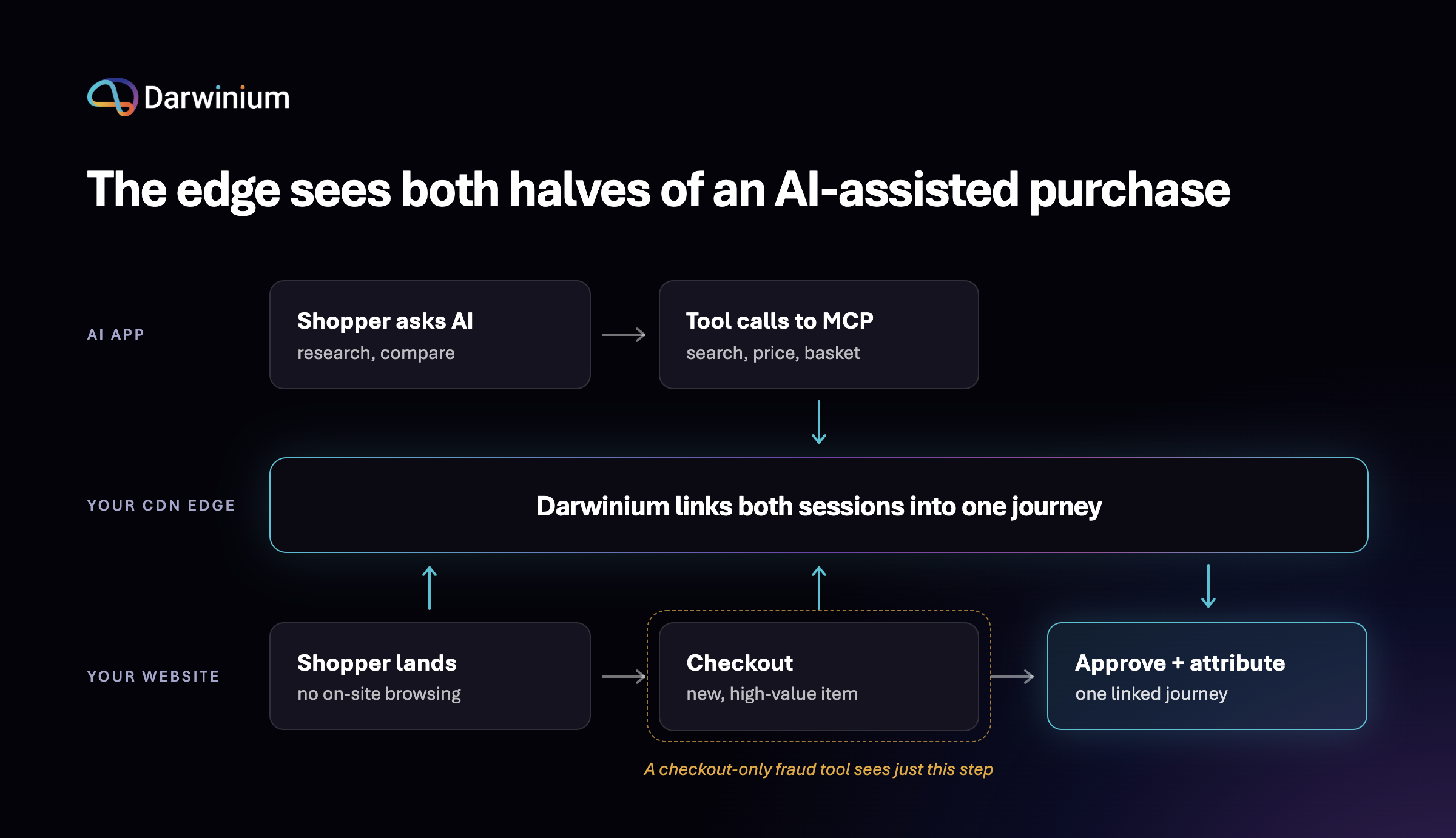
AI app session and website session, linked at the edge
The checkout decision then uses the whole journey. Device, network and behavioral biometrics confirm that a real person is completing the purchase, and the MCP history explains why that person went straight to a high-value item. The same record shows marketing which AI app started the journey and which queries led to the sale.
What does a linked AI shopping journey give fraud and marketing teams?
Fraud teams can approve more good customers. A session that looked like "no browsing, straight to checkout" now carries the products searched, the alternatives compared and the basket built in the AI app. Real fraud still shows up, for example when the AI session and the checkout don't match, or when an agent has been steered into abuse.
Marketers get attribution based on events the retailer observed itself. The retailer can see which AI apps sent tool calls, which queries led to which products, and which of those journeys ended in a completed order that wasn't disputed. This is first-party data from the retailer's own edge.
Both teams also work from the same record. Darwinium's full-journey fraud prevention capabilities help businesses connect digital interactions, evaluate risk in context and take action in real time. This creates a foundation for fraud and marketing teams to work from a shared view of the customer journey.
Oddly, a16z frames attribution as a marketing problem, but the infrastructure that answers it was built for fraud prevention: observing every request from every surface and linking it to one actor's journey.
As AI grows from about 11% of US desktop shopper journeys, the gap will show up in approval rates and in attribution reports. Retailers that link the journey will know which AI recommendations turned into revenue. Retailers that see only the checkout will keep guessing, and some of their best new customers will be declined. To find out how many of your checkouts start in an AI app, talk to Darwinium.
Frequently asked questions
Do most AI-assisted purchases happen inside the AI app?
No. In Similarweb's 2026 US desktop data, AI was the last touchpoint before a transactional site in 18.4% of sessions that used it, and 42% of US consumers told Statista they would not trust AI to make purchases for them. Most AI-assisted purchases are completed by a person on the retailer's website.
Why would a fraud tool decline a customer who used AI to research?
A tool that only sees the checkout sees a new session with no browsing, a deep link and a high-value item bought quickly. Those are common card-not-present fraud signals. The research that explains the purchase happened in the AI app, where the tool has no visibility.
Can Darwinium see the user's conversation with the AI app?
No. Darwinium sees the tool calls the AI app makes to the retailer's own MCP server or APIs, such as product searches and basket actions. The conversation itself stays with the AI provider.
How is the AI session linked to the website session?
Through a trusted correlation value that carries across both sessions, such as a handoff link, a cart token or a login to the same customer account. Darwinium uses it to assign both sessions one journey ID.
Sources
- Moses Sternstein, "This Week in Charts: Agents Denied", a16z, 16 October 2026, citing Cloudflare Radar, the National Retail Federation and Goldman Sachs, the 2026 Global Payments & Fraud Report, the Statista Consumer Reality Update 2026, and Similarweb.